 by
by 
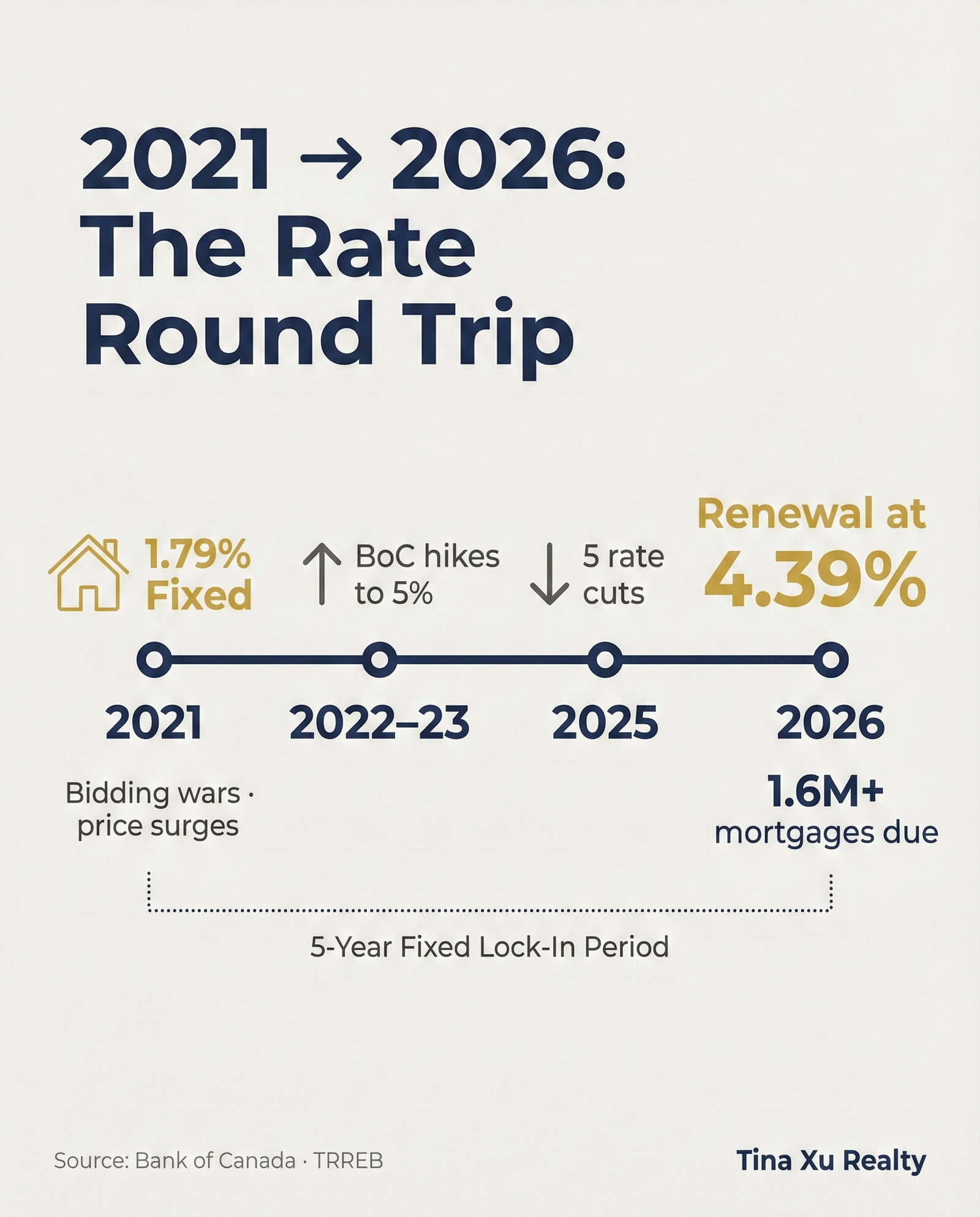
The Bank of Canada cut rates five times last year. The overnight rate dropped from 5% to 2.25%. By every surface-level reading, mortgage holders should be breathing easier.
But if you locked a five-year fixed rate in 2021, your renewal letter this year tells a different story. Your new rate isn’t 1.79% anymore. It’s north of 4%. And the monthly payment shock is real — roughly 800,000 mortgage.
That math doesn’t feel like a rate-cutting environment. It feels like a trap.
Here’s the framework for thinking through it — whether you’re an owner-occupier weighing the hit to your cash flow, or an investor re-running the numbers on a property that’s gone from positive to negative.
1.6 million mortgages are renewing this year — and most were locked at rates that no longer exist
2021 was an anomaly. The Bank of Canada’s benchmark rate sat at 0.25%. Five-year fixed mortgages were available between 1.5% and 1.99%. Qualification was comparatively easy, competition was fierce, and Canadians borrowed heavily.
Those five-year terms are now expiring — all at once. According to the Bank of Canada, between 1.6 and 1.8 million mortgages will come up for renewal in 2026. The vast majority were originated during that ultra-low window.
Here’s what the rate environment looks like on both sides:
| Metric | 2021 (Origination) | 2026 (Renewal) |
|---|---|---|
| 5-Year Fixed | 1.79% | 4.39% |
| Stress Test Rate | 5.25% | ~6.5% |
| Prime Rate | 2.45% | 4.45% |
That 2.6 percentage-point jump doesn’t sound dramatic in isolation. But on a large mortgage over 20+ years, it changes everything.
The payment shock is real — but the hidden cost is worse
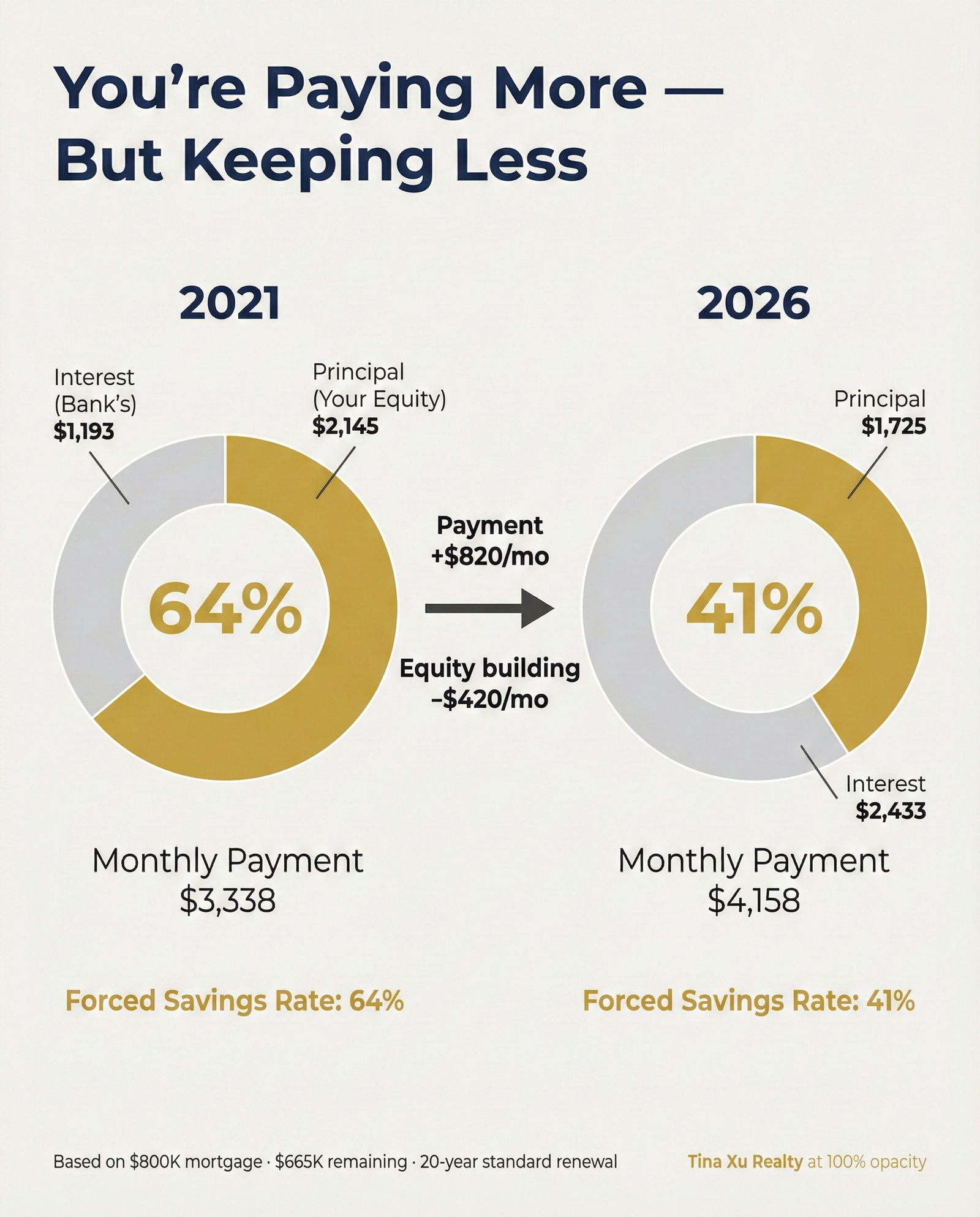
On an 3,338. After five years of payments, the remaining balance is approximately 4,158.
That’s 10,000 per year.
But the number that matters more is the one inside the payment.
In 2021, out of every 2,145 went to principal. You were building equity at a rate of 64 cents per dollar paid. Forced savings of 64%.
After renewal? The payment rises to 1,725. Your forced savings rate falls to 41%.
You’re paying more. Keeping less. Squeezed from both sides.
This is the part of the renewal shock that doesn’t show up in most commentary. It’s not just cash flow. It’s wealth-building efficiency going backward.
Extending the amortization looks gentle — until you add it up
The instinctive move is to extend the amortization. Push it from 20 years back to 25 or 30. The monthly increase shrinks to roughly 820.
Sounds reasonable. But it reverses five years of principal progress and adds six figures in total interest over the life of the mortgage.
The softest option on the surface is often the most expensive when you actually run the numbers through to completion. It’s a comfort trade — lower monthly pain now, higher total cost later. Worth understanding before signing.
If you’re thinking about selling — three exit costs that surprise people
For some homeowners, especially investors carrying negative cash flow, selling feels like the rational response. In many cases, it is. But the exit math in 2026 has a few wrinkles that catch people off guard.
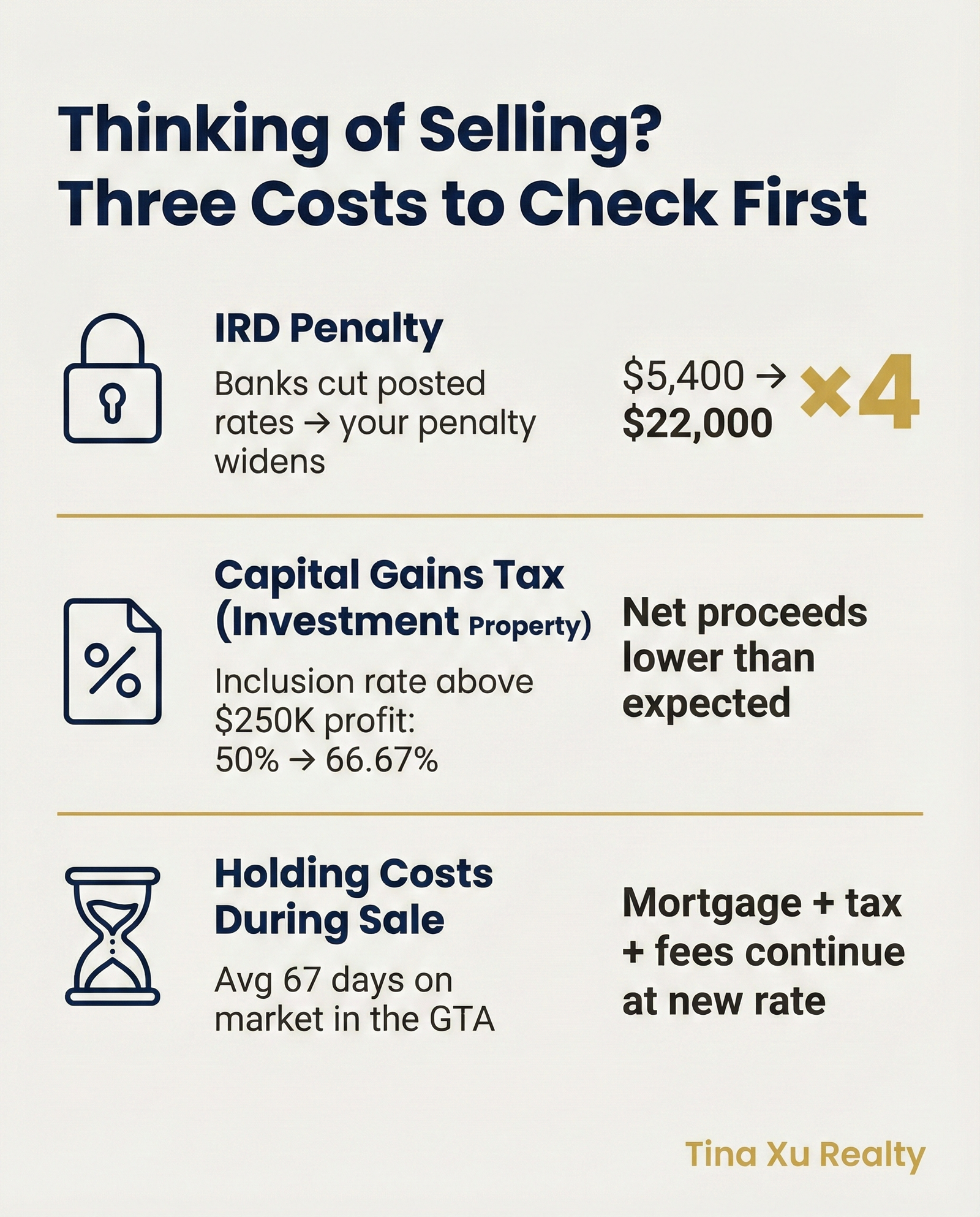
1. IRD penalties have quietly quadrupled.
If you’re breaking a fixed-rate mortgage early, the Interest Rate Differential (IRD) penalty is calculated using the gap between your contract rate and the bank’s current posted rate. Banks have aggressively cut posted rates in 2026 to attract new clients — which widens the gap against your old contract.
Result: on a 5,400 to $22,000. Nearly four times higher. Same mortgage, same bank, same clause — just a different rate environment.
2. Capital gains tax rules have changed.
As of January 2026, capital gains above $250,000 are now taxed at a 66.67% inclusion rate, up from 50%. If you’re selling an investment property with significant appreciation, the net proceeds will be lower than what most people assume based on the old rules.
3. Holding costs during the sale process add up fast.
Average days on market in the GTA is currently 67 days. From listing to closing, you’re carrying two-plus months of mortgage payments, property taxes, and maintenance fees — all at the new, higher rate.
Three paths — depending on where you sit
The right move depends on your specific situation. Here’s the decision framework I walk clients through:
If you’re an owner-occupier and the higher payment is manageable:
Before you sign the renewal, check whether you have available cash for a lump-sum payment. On a 50,000 down at renewal reduces the monthly payment from 3,845 — a savings of $313 per month. The effective after-tax return on that lump sum is 4.39%, which is better than most GICs and carries zero risk.
For households dealing with a sudden cash-flow squeeze, this is often the single highest-ROI move available.
If you’re an investor and the property has gone cash-flow negative:
Put the full picture on one spreadsheet: new monthly payment, rental income, IRD penalty (if breaking early), capital gains tax liability, property tax, management fees. Compare the cumulative 12-month holding cost against the net proceeds of selling today.
In many cases I’ve reviewed, the math favours selling — the cumulative carrying loss exceeds the one-time cost of exiting. But if your term is naturally expiring this year (no early-break penalty), renewing and holding for 12 months while you reassess can be defensible, provided the cash flow gap is manageable.
If you haven’t decided — but the renewal date is approaching:
Two concrete steps. First, request a Payout Statement from your lender. This is the precise, system-generated cost of exiting your current mortgage today — not an estimate, not a guess. Every subsequent decision needs this number as its foundation.
Second, check whether your mortgage has a porting clause. Porting lets you transfer your existing rate to a new property. If you’re considering selling and buying, this can materially change the math.
The structural reality behind the numbers
The 2021 rate environment was a historical outlier. Fixed rates below 2% existed for roughly 18 months in the last 50 years. Renewing at 4.39% isn’t a penalty — it’s a return to normal. But “normal” feels expensive when you’ve been paying $820 less per month for the last five years.
The uncomfortable truth: 1.6 million Canadian households are discovering this simultaneously. And not all of them will have the flexibility to choose their preferred path. OSFI’s B-20 stress test means that switching lenders requires qualifying at approximately 6.5% — which effectively locks many borrowers into their existing bank’s renewal offer unless their income has increased by 30%+ since origination.
This is the hidden feature of the 2026 renewal wave: not everyone gets to shop around.
My read
Renewal isn’t optional. The date arrives whether you’re ready or not, and the bank won’t wait for you to finish weighing your options.
But the decision doesn’t have to be reactive. Whether you renew, restructure, or exit — the difference between a good outcome and a stressful one is almost always having run the numbers before the deadline, not after.
If you’re approaching renewal this year and want to map out the scenarios — lump-sum impact, exit costs, hold-vs-sell comparison — feel free to reach out. I’d rather walk through the math with you now than troubleshoot a rushed decision later.
Based on publicly available data from the Bank of Canada, OSFI, and TRREB. Not financial advice. Consult your mortgage specialist and accountant for decisions specific to your situation.


Join The Discussion